Specialized HEC for Oil-Well Cementing: Regulating Thickening Time to Enhance Cementing Safety


İçinde oil and gas well cementing operations, the thickening time of cement slurry is regarded as the “lifeline” that determines the success or failure of the entire operation. If the thickening time is too short, the cement slurry may lose its fluidity before being properly displaced into place, leading to severe consequences such as pump stalling or leaving excessive cement plugs. Conversely, if the thickening time is too long, it prolongs the operation cycle and increases both costs and risks. Hydroxyethyl cellulose (HEC), as a critical additive in cementing slurries, serves a purpose far beyond thickening and fluid-loss control. Its core value lies in the precise regulation of thickening time, fundamentally ensuring the safety and reliability of cementing operations.
Thickening time is defined as the duration from the moment of slurry mixing until its consistency reaches a specified value (100 Bearden units, or 100 Bc, as defined by API standards). During cementing operations—from mixing and blending to pumping and displacement—all procedures must be completed before the cement slurry thickens beyond this threshold. Once the thickening time is insufficient and the slurry consistency rises sharply during pumping, it can no longer be effectively displaced. At best, this leaves excessive cement plugs; at worst, it may result in the complete abandonment of the well.
It is important to recognize that a longer thickening time is not always better. An ideal cementing slurry should exhibit a dual characteristic: a sufficiently long pumping period, followed by rapid thickening once it reaches the target formation. In deep and ultra-deep well operations, downhole temperatures and pressures are exceptionally high. For every 5°C increase in temperature, the thickening time decreases by a measurable margin. Therefore, the cement slurry system must possess excellent adjustability in thickening time, enabling precise formulation tailored to actual well conditions.
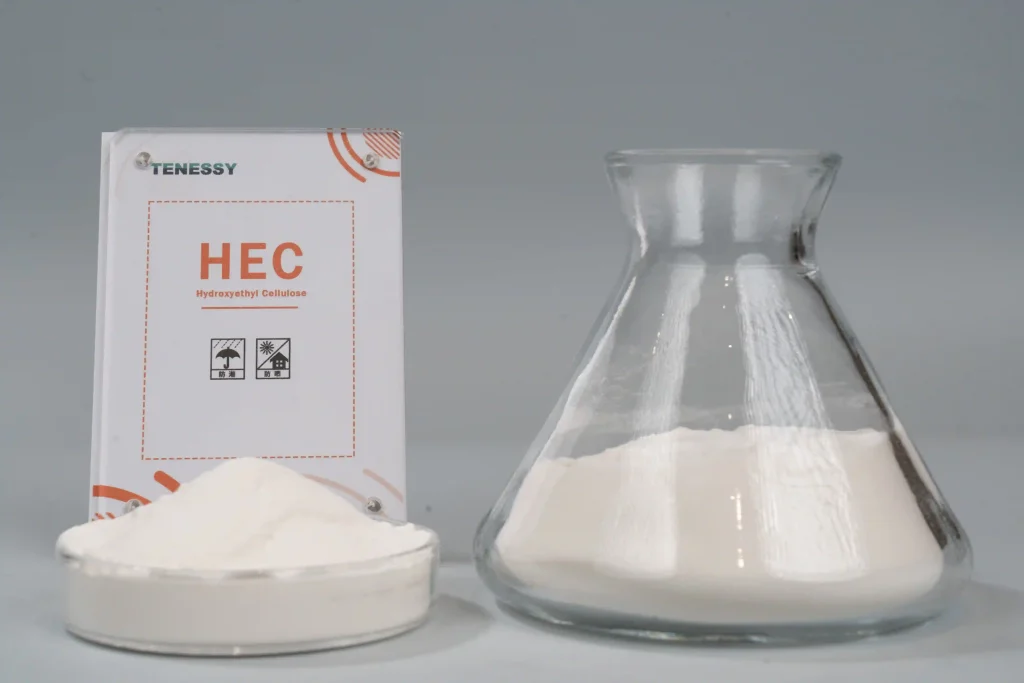
Hydroxyethyl cellulose is a non-ionic, water-soluble polymer that dissolves readily in both cold and hot water, remains stable without precipitation at elevated temperatures, and exhibits unique non-thermogelling properties. In oil-well cement slurry systems, HEC regulates thickening time through the following mechanisms:
The hydroxyl groups on the HEC molecular chains form hydrogen bonds with water molecules, significantly increasing the viscosity of the liquid phase. This thickening effect not only improves the suspension stability of the slurry but also retards the hydration reaction of cement particles by reducing ion diffusion rates. Research data indicates that incorporating approximately 0.4% HEC into cementing formulations, in combination with geciktiriciler, can extend the thickening time from 134 minutes to over 248 minutes, while maintaining free-water content below 1%.
The high-temperature environments encountered in cementing operations impose stringent demands on the thermal stability of cellulose ethers. HEC demonstrates excellent fluid-loss control performance at temperatures up to approximately 82°C (180°F). When formulated with specific additives, it remains effective at bottom-hole circulating temperatures up to approximately 110°C (230°F). This characteristic enables it to meet the requirements of most conventional and moderately high-temperature cementing operations.
Another critical contribution of HEC is its ability, when combined with retarders, to impart a “right-angle thickening” characteristic to the cement slurry—where the consistency rapidly increases from 30 Bc to 100 Bc within an extremely short period (typically no more than 30 minutes). This behavior ensures that the cement slurry remains at low consistency and pumps easily during displacement. Once in place, it rapidly develops strength, effectively preventing oil, gas, and water channeling, thereby safeguarding cementing quality.
HEC possesses a water-retention capacity significantly higher than that of methyl cellulose, substantially reducing the filtrate loss of cement slurry. Once the cement slurry enters the open-hole section, excessive fluid loss increases the water-to-cement ratio and density, which in turn shortens the thickening time. By forming a dense filter cake and increasing the viscosity of the liquid phase, HEC effectively controls fluid loss, prevents premature thickening induced by excessive filtration, and maintains hydrostatic column pressure, thereby mitigating the risk of gas channeling.
HEC also effectively inhibits sedimentation and free-water separation in cement slurries. Actual formulation data show that cement slurries incorporating 0.4% HEC can maintain free-water content below 1%, significantly outperforming systems without HEC, which typically exhibit free-water levels around 3.8%. This property ensures density uniformity throughout long-sealing-section operations, preventing displacement efficiency losses caused by excessive density differentials between the top and bottom of the column.
Cementing operations represent the “final critical step” in drilling engineering, directly determining the long-term safety and production capacity of the wellbore throughout its entire lifecycle. Hydroxyethyl cellulose (HEC), as a core specialty additive for oil-well cement slurries, provides multidimensional technical assurance for operational safety through hydration retardation, precise thickening-time regulation, fluid-loss control, and slurry stabilization.
TENESSY is committed to delivering high-quality HEC products for oil and gas well cementing applications. With its excellent thickening performance, high-temperature stability, and resistance to salt and contamination, TENESSY HEC empowers cementing engineers to achieve “precise control, safe and efficient” operational outcomes under complex downhole conditions. Choosing specialty HEC is choosing a solid foundation for every well’s cementing quality and long-term integrity.
TENESSY, 10 yılı aşkın üretim tecrübesine ve gelişmiş üretim ekipmanlarına sahiptir.


Ücretsiz numune almak için doldurun veya daha fazla bilgi için danışın.
