Hydroxypropyl Methylcellulose Demonstrates Excellent Electrolyte Resistance in High-Salt Washing Systems

This exceptional performance is primarily attributed to its non-ionic molecular structure. Compared to ionic thickeners (such as CMC), HPMC maintains stable viscosity in detergent formulations containing high concentrations of sodium salts (NaCl, Na₂SO₄, etc.), and is less prone to the “salting-out” phenomenon.

A high-salt environment is a “nightmare” for most thickeners. Electrolyte challenges are mainly manifested in the following aspects:
Viscosity Collapse: In high-salt environments, the charged groups of ionic thickeners (such as CMC and polyacrylates) are shielded by electrolytes. Their molecular chains transition from an extended state to a coiled state, leading to a sharp reduction in hydrodynamic volume, with viscosity potentially dropping by 50-80%.
Phase Separation and Precipitation: When the compatibility between the thickener and the electrolyte is poor, a “salting-out” phenomenon may occur—the polymer precipitates out of the solution, forming flocs or sediment layers, severely compromising product appearance and stability.
Exacerbated Temperature Sensitivity: High-salt systems are often more sensitive to temperature changes. During high-temperature summer storage, viscosity may plummet; in winter, excessive thickening or even gelation can occur, affecting the user experience.
Synergy Failure with Other Components: Salts can interfere with the interaction between thickeners and functional ingredients such as surfactants, enzymes, and perfume microcapsules, leading to the degradation of the entire formulation’s performance.
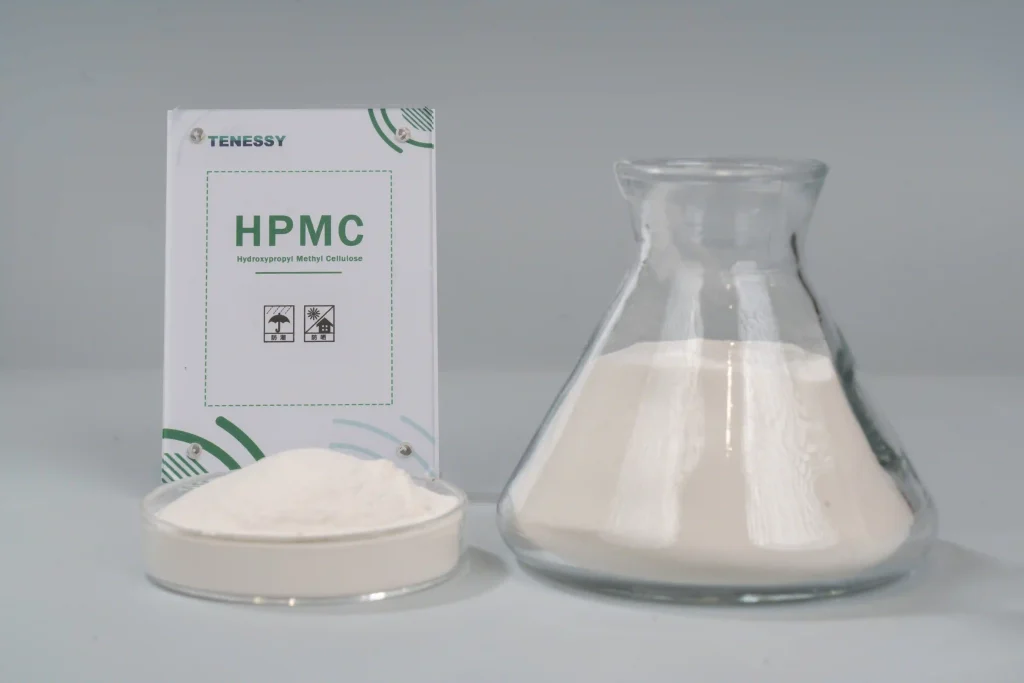
HPMC‘s salt tolerance stems from its non-ionic molecular structure. Unlike anionic cellulose ethers such as CMC, the HPMC molecular chain carries no charged groups:
HPMC Molecular Structure Characteristics:
Main Chain: Composed of glucose units linked by β-1,4-glycosidic bonds
Substituents: Methyl (-OCH₃) and Hydroxypropyl (-OCH₂CHOHCH₃) groups, randomly distributed
Degree of Substitution (DS): Methoxyl content 19-30%, Hydroxypropoxyl content 4-12%
Charge State: Completely neutral, zero charge density
Scientific Explanation of the Salt Tolerance Mechanism:
When an electrolyte (e.g., NaCl) dissolves in water, it dissociates into Na⁺ and Cl⁻ ions. These ions form an “ion atmosphere” in the water, creating a screening effect on charged particles.
For Anionic Thickeners (e.g., CMC):
The carboxylate groups (-COO⁻) on the molecular chain carry negative charges.
Electrolyte cations (Na⁺) are attracted to the polymer chain.
Electrostatic repulsion is screened, causing the molecular chain to coil.
Hydrodynamic volume ↓ → Viscosity ↓
For Non-Ionic HPMC:
The molecular chain carries no charge, so there are no electrostatic interactions.
Electrolyte ions have “nowhere to attach” and cannot influence the chain conformation.
The hydration layer is maintained through hydrogen bonding and is insensitive to salt.
Viscosity Stability ↑ → Formulation Reliability ↑
The salt tolerance of HPMC is not fixed but is closely related to its Grau de substituição (DS):
Substitution Range | Methoxyl Content | Hydroxypropoxyl Content | Salt Tolerance Rating | Applicable Scenario |
Low (DS < 1.5) | 19-22% | 4-7% | ★★☆☆☆ | Low-salt systems |
Medium (DS 1.5-1.8) | 22-26% | 7-10% | ★★★☆☆ | Medium salt concentration |
High (DS > 1.8) | 26-30% | 10-12% | ★★★★★ | High-salt / Concentrated systems |
Table 1: Relationship between HPMC Substitution Degree and Salt Tolerance Performance
Salt Tolerance Advantages of High-Substitution HPMC:
Steric Hindrance Effect: High substitution means more methoxyl and hydroxypropyl side chains. These hydrophilic groups form a “protective layer” around the main chain, hindering electrolyte ions from approaching.
Enhanced Hydrogen Bonding Network: The hydroxyl groups (-OH) in hydroxypropyl can form additional hydrogen bonds with water molecules, enhancing the stability of the hydration layer even in high-salt environments.
Gelation Temperature Adjustment: The gelation temperature of high-substitution HPMC is typically between 60-75°C, higher than most storage and transportation conditions, ensuring the product remains liquid even in tropical regions.
The viscosity grade of HPMC (expressed in mPa·s for a 2% aqueous solution) directly affects its thickening efficiency in detergents. For high-salt washing systems, the following viscosity ranges are recommended:
Cenário do aplicativo | Recommended Viscosity Grade | Typical Dosage | Final Product Viscosity |
Light-duty Hand Soap | 3,000-10,000 | 0.3-0.5% | 500-2,000 mPa·s |
General-purpose Laundry Liquid | 10,000-50,000 | 0.3-0.8% | 1,000-5,000 mPa·s |
Concentrated Laundry Liquid | 50,000-100,000 | 0.5-1.0% | 3,000-10,000 mPa·s |
Super-concentrated / Pod Formula | 100,000-200,000 | 0.8-1.5% | 5,000-20,000 mPa·s |
Industrial Heavy-duty Cleaner | 150,000-200,000 | 1.0-2.0% | 10,000-50,000 mPa·s |
Table 2: HPMC Viscosity Grade Matching with Detergent Application Scenarios
Unique Value of High Viscosity HPMC (150,000-200,000 mPa·s) in High-Salt Systems:
High Efficiency at Low Dosage: Achieves target viscosity with only 0.5-1.0%, reducing formulation costs.
Shear Dilution Resistance: Pseudoplastic (shear-thinning) characteristics ensure the product is easy to pour and pump.
Long-term Stability: 12-month accelerated aging tests show viscosity retention >92%.
Suspension Capability: Effectively suspends functional ingredients like enzymes, optical brighteners, and perfume microcapsules.
HPMC‘s most fundamental and important function is espessamento e rheology control. In high-salt washing systems, this function faces a dual challenge: overcoming the negative impact of salt on viscosity while achieving the desired rheological profile.
HPMC Thickening Mechanism:
Hydration Swelling: Hydroxyl and ether groups on the HPMC molecular chain form hydrogen bonds with water molecules, allowing the polymer chain to fully extend and occupy a large hydrodynamic volume.
Chain Entanglement Effect: As concentration increases, molecular chains intertwine, forming a three-dimensional network structure.
Physical Cross-linking: The hydrophobic methoxyl regions of high-substitution HPMC can form weak hydrophobic interactions, enhancing network strength.
The core mission of a detergent is to remove dirt, but if dirt redeposits onto clothes during the rinsing phase, the effort is wasted. Anti-redeposition is another key function HPMC demonstrates in high-salt systems.
HPMC Prevents Dirt Redeposition Through Three Mechanisms:
Steric Stabilization: HPMC molecules adsorb onto the surface of dirt particles, forming a thick hydration layer that prevents particles from approaching each other and aggregating.
Electrostatic Shielding: Although HPMC itself carries no charge, its hydration layer can shield the electrostatic attraction between dirt particles and fabric fibers, reducing adsorption.
Film Barrier: HPMC forms an extremely thin, transparent protective film on the fiber surface, making it difficult for dirt particles to directly contact the fiber.
Modern detergents often contain various functional suspended components: enzymes (protease, lipase, amylase), optical brighteners, perfume microcapsules, colorants, etc. The density and solubility of these components vary, making them prone to sedimentation or stratification during storage.
HPMC Suspension Mechanism:
Viscosity Increase: Increases the viscosity of the continuous phase, slowing down the settling velocity of particles (Stokes’ Law: settling velocity ∝ 1/viscosity).
Yield Stress: Forms a weak gel network that “locks” particles in a suspended position under static conditions.
Thixotropy: Viscosity decreases under shear (e.g., shaking, pouring) and recovers rapidly upon standing, balancing suspendability and flowability.
Foam is an important indicator for consumers to perceive washing effectiveness – too little foam seems “not clean,” while too much foam makes rinsing difficult and wastes water. HPMC enables precise foam control in high-salt systems.
HPMC Foam Regulation Mechanism:
Surface Activity Modulation: HPMC itself possesses some surface activity (surface tension: 42-56 dyn/cm) and can synergize with surfactants to optimize foam structure.
Liquid Film Stabilization: HPMC increases the viscosity and elasticity of the foam liquid film, slowing down drainage, resulting in finer, more persistent foam.
Defoaming and Antifoaming: In formulations requiring low foam (e.g., dishwasher detergents, washing machine cleaners), HPMC can promote bubble collapse by altering the rheological properties of the liquid film.
HPMC’s film-forming ability is a unique advantage distinguishing it from other thickeners. During the washing process, HPMC can form an extremely thin, transparent, and flexible protective film on the fiber surface:
Film Formation Mechanism and Function:
Physical Barrier: The film layer blocks direct contact between dirt and fibers, reducing redeposition.
Lubrication and Friction Reduction: Reduces the friction coefficient between fibers, minimizing washing wear and tear.
Antistatic: The film layer has certain hygroscopicity, reducing static buildup.
Soft Feel: The film layer fills micro-defects on the fiber surface, making the feel smoother.
Choosing TENESSIA means not only selecting high-quality products but also opting for comprehensive technical support:
Sample Testing Service:
Standard formulas and testing method guidance provided
Preliminary test report issued within 48 hours
Formulation Development Support:
One-on-one serviço from senior application engineers
HPMC selection optimization for specific salt concentrations and surfactant systems
A TENESSY tem mais de 10 anos de experiência em produção e equipamentos de produção avançados.


Preencha o formulário para obter uma amostra grátis ou consulte para obter mais informações.
