tenessy logo

Hydroxypropyl Starch Ether: How to Make Coal Briquette Production More Stable, Strong, and Eco-Friendly

The Role of Hydroxypropyl Starch Ether

Coal briquettes are widely used for industrial fuel, heating, and gasification. However, many manufacturers still face problems such as low strength, poor water resistance, complex production processes, and high costs. Today, hydroxypropyl starch ether, a modified starch binder, offers an effective solution to these challenges.

This article explains common briquette production problems, how starch ether works, and why it is becoming a new-generation eco-friendly binder for coal briquettes.

Common Problems in Coal Briquette Production

1. Low Binding Strength

Many traditional binders do not provide enough strength:

  • Low wet strength: Briquettes crack or break during transportation and drying
  • Poor hot strength: Organic binders decompose at high temperatures, causing briquettes to collapse during combustion or gasification
  • High dosage required: Ordinary starch often needs 4–6% or more, increasing cost and reducing coal’s calorific value

2. Poor Process Adaptability

Traditional binders are difficult to use in modern production lines:

  • High-temperature gelatinization required: Ordinary starch must be heated to 60–80°C, increasing energy consumption
  • Long processing time: Humic acid binders need alkaline cooking and long fermentation, making continuous production difficult
  • Rainy season problems: Poor moisture control makes production unstable in humid environments

3. Weak Water Resistance

  • Briquettes absorb moisture easily and become soft
  • Storage and transportation are limited
  • Moisture content must be strictly controlled (usually 5–15%), which is difficult in practice

4. Environmental and Cost Conflicts

  • Inorganic binders (clay, bentonite) increase ash content and reduce heating value
  • Low-quality binders may contain sulfur or heavy metals, releasing harmful gases
  • High-performance chemical binders are often too expensive for large-scale use

What Is Starch Ether and How Is It Used in Briquettes?

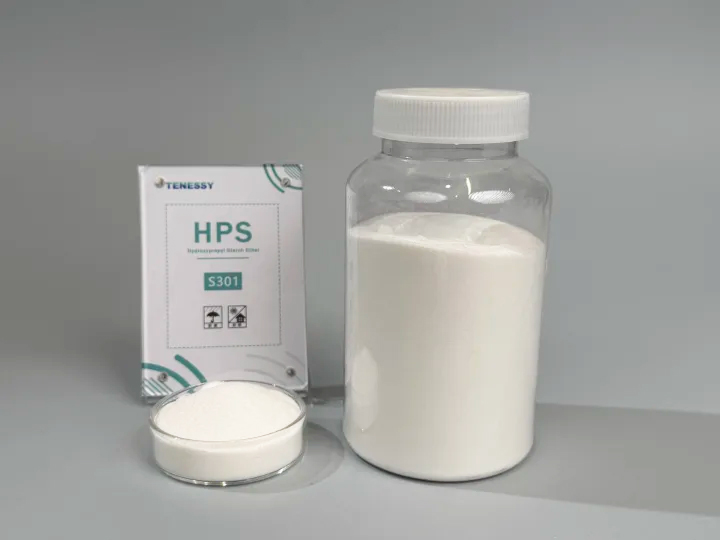
Starch ether is a chemically modified starch. In coal briquette production, it works mainly as:
  • A binder to improve strength
  • A performance modifier to improve water resistance and processing efficiency
Some starch ethers, such as hydroxypropyl starch ether, can dissolve quickly in cold water and form strong bonding films between coal particles.

Advantages of Hydroxypropyl Starch Ether vs. Ordinary Starch

PerformanceOrdinary StarchHydroxypropyl Starch Ether
SolubilityNeeds heatingDissolves in cold water
Binding strengthMediumMuch higher cold & hot strength
Water resistancePoorSignificantly improved
Dosage4–6%Only 1.5–3%
Environmental impactEco-friendlyEco-friendly with better performance
Overall costLow unit priceLower total cost due to lower dosage

burning-Coal-Briquette

Key Benefits of Using Hydroxypropyl Starch Ether

Starch ether (especially Tenessy Hydroxypropyl Starch Ether) addresses the above problems through chemical modification:

1. Stronger and More Stable Briquettes

  • Cold-water soluble: No heating or gelatinization needed
  • Lower dosage: Only 1.5–3% of coal weight
  • Strength improvement:
    • Compressive strength increases by 30–50%
    • Drop resistance improves significantly
    • Hot strength can be enhanced when combined with inorganic binders

2. Easier and Faster Production Process

  • Quickly wets coal particles and shortens mixing time
  • Enables continuous production: mixing → forming → drying
  • Colorless, odorless, and non-corrosive, improving the working environment

3. Better Water Resistance and Storage Performance

  • Ether bond structure reduces moisture absorption
  • Forms a uniform protective film on coal particles
  • Briquettes stay stable during storage and are less affected by humidity

4. Economic and Environmental Benefits

  • No reduction in calorific value and no added ash
  • Burns cleanly without harmful residues
  • Improves combustion efficiency and can reduce coal consumption by 20–30%
  • Overall production cost can be reduced by 10–20%

How Hydroxypropyl Starch Ether Works

1. Working Mechanism

Through chemical modification, functional groups are introduced into the starch molecule, giving it the following properties:

  • Cold-water solubility
  • Strong adhesion between coal particles
  • Stable viscosity under alkaline conditions
  • Good anti-sagging performance before forming

2. Performance Improvement Comparison

ProblemTraditional BinderStarch Ether EffectResult
Low wet strengthWeak bondingTough, flexible filmBreakage ↓70%
Complex processHeating requiredCold-water solubleEnergy ↓60%
Poor water resistanceAbsorbs moistureStable ether bondsMoisture uptake ↓80%
High dosage3–6%1.5–3%Binder cost ↓30%
Environmental riskPossible pollutantsPlant-based, cleanNo harmful emissions

Practical Application Recommendations

  • Recommended formulation:
    Hydroxypropyl starch ether + bentonite (3–5%) + calcium lignosulfonate (0.1–0.3%)
  • Addition method:
    Add as a 5–10% aqueous solution during coal powder mixing, mix for 5–8 minutes
  • Suitable coal types:
    Bituminous coal and anthracite with 12–20% volatile matter
    Higher dosage may be needed for highly metamorphic coal
  • Cost optimization:
    When used with HPMC, HPMC dosage can be reduced by 30–50%
Tags :
Uncategorized
Share This :

Get in touch with us

Fill in to get a free sample or consult for more information.

Contact Information