How to Use Gypsum Retarder? A Beginner-Friendly Guide
Controlling the setting time is one of the most important steps when working with gypsum-based materials—whether it’s gypsum plaster, self-leveling mortar, or gypsum blocks.
If the setting is too fast, workers don’t have enough time to apply or finish the material. If it’s too slow, the project gets delayed.
That’s why a gypsum retarder is essential.
This beginner-friendly guide will help you understand how gypsum retarders work, how to choose the right one, and how to use them correctly to get the best performance.
What Is a Gypsum Retarder?
A gypsum retarder is an additive designed to slow down the setting time of gypsum.
Without a retarder, gypsum may harden too quickly, causing:
- Poor workability
- Uneven finishing
- Wasted material
- Stressful, rushed application
A proper retarder gives you more “open time,” allowing smoother application whether you’re hand-plastering or using a spraying machine.
In modern construction mixes, retarders also help reduce waste, improve working efficiency, and keep the setting time stable—especially in hot climates or large-scale projects.
Types of Gypsum Retarders: Which One Do You Need?
Gypsum retarders come in different types, and each one behaves differently:
⋅ Citric Acid-Based Retarders
Common but may cause unstable setting in some formulas.
⋅ Protein-Based Retarders
Natural ingredients but easily affected by bacteria and moisture.
⋅ Synthetic Polymer Retarders
Good performance but usually more expensive.
Recommended: Amino Acid-Based Gypsum Retarder (TENESSY)
TENESSY focuses on amino acid-based retarders, which offer several advantages:
- Eco-friendly and biodegradable
- Works at low dosage (0.03%–0.3%)
- Very stable and consistent
- Good compatibility with different gypsum types and additives
If you need a reliable retarder without the common drawbacks of traditional products, amino acid-based retarders are a smart choice.
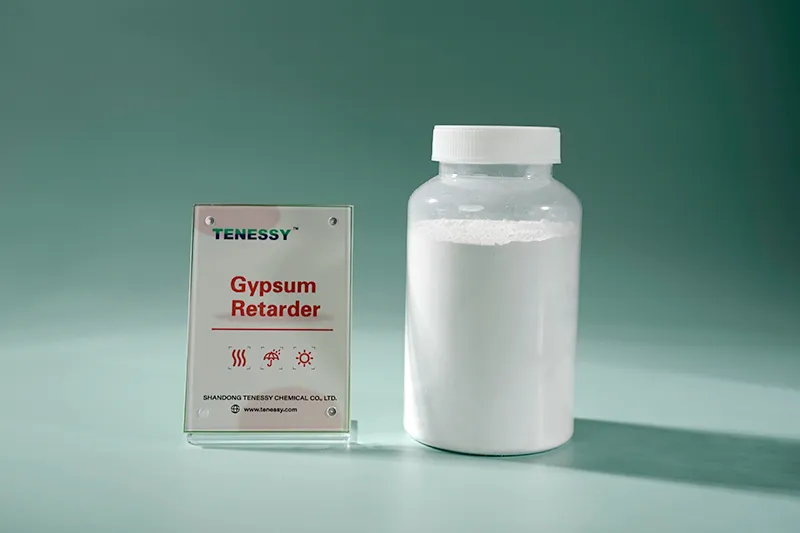
How to Use a Gypsum Retarder Correctly
Using a gypsum retarder is simple, but following the right steps is important to get stable results.
1. When to Add It
- Dry-mix mortar production → Add during the dry blending stage.
- On-site mixing → Add to the water or dry powder, but mix thoroughly to ensure even distribution.
2. Recommended Dosage
For amino acid-based retarders, the effective dosage is 0.1% to 0.3% of the total gypsum weight.
Always start with a lower amount and adjust after testing.
3. Mixing Tips
- Ensure even mixing to avoid areas that set too fast or too slow.
- Do not ignore the water-to-gypsum ratio, as it also affects setting time.
Before large-scale production, always run a small batch test.
Sample Gypsum Plaster Formula with Retarder
Below is a typical formula structure when using a gypsum retarder:
1. Standard Formula:
| Raw Material | Weight (kg) |
|---|---|
| Desulfurized Gypsum | 750 |
| Heavy Calcium Powder (with optional 300-mesh stone powder) | 150 |
| Expanded Perlite | 50 |
| HPMC | 1.5–2.5 |
| Starch Ether | 0.5–1 |
| Gypsum Retarder | 1–1.5 |
*Water ratio: 1 : 2
2. Application Tips
- Hand plastering → Normal dosage works well.
- Spray plastering → You may adjust slightly for faster operation.
- Repair mortar → Lower dosage is usually enough.
This formula gives good open time, smooth finishing, and strong adhesion.


Common Mistakes Beginners Should Avoid
If you’re new to gypsum retarders, watch out for these issues:
- Adding too much, causing the gypsum not to set at all
- Uneven mixing, leading to inconsistent hardening
- Ignoring compatibility, as not all retarders suit every gypsum source
- Forgetting climate factors—hot and dry conditions may require extra dosage
With careful testing, you can easily achieve stable and predictable results.
How to Choose a Reliable Gypsum Retarder Supplier
A good supplier should provide:
- Stable and consistent product quality
- Formula recommendations and technical support
- Customized solutions for different gypsum sources and climate conditions
TENESSY is not only a manufacturer but also an experienced exporter working with global partners, supporting both large factories and growing distributors.
Final Thoughts
Knowing how to use gypsum retarders properly is essential for getting the best performance from your gypsum products.
From controlling setting time to improving workability and surface quality, the right retarder makes your construction process smoother and more efficient.
If you need help with formulas, product selection, or dosage adjustment, feel free to ask—I can help you optimize your mix anytime.
Recent Posts
Products
- HPMC - Hydroxypropyl Methyl Cellulose
- HEMC - Hydroxyethyl Methyl Cellulose
- HEC - Hydroxyethyl Cellulose
- CMC - Carboxymethyl Cellulose
- PAC - Polyanionic Cellulose
- HPS - Hydroxypropyl starch ether
- RDP - Redispersible Polymer Powder
- Polycarboxylate Superplasticizer
- Silicone Hydrophobic Powder
- Gypsum Retarder
- Powder Defoamer