Application Study of Hydroxyethyl Cellulose (HEC) in Fire-Resistant Coatings

Fire-resistant coatings are functional الطلاءات capable of forming an insulating char layer under fire conditions, delaying substrate temperature rise, and protecting buildings and steel structures. They are widely used in industrial and civil buildings, tunnels, petrochemical facilities, and other infrastructure.
Due to their environmental friendliness, safety, and ease of application, water-based fire-resistant coatings have become the mainstream development direction in the industry.
هيدروكسي إيثيل السليلوز (HEC), a non-ionic water-soluble polymer, has become an indispensable additive in water-based fire-resistant coating formulations. With excellent thickening, water retention, suspension, thixotropic properties, and system compatibility, HEC directly affects storage stability, workability, film quality, and final fire protection performance.
This article systematically discusses the mechanism, performance advantages, selection criteria, formulation applications, and comparative analysis of HEC in fire-resistant coatings, providing reference for production and R&D.
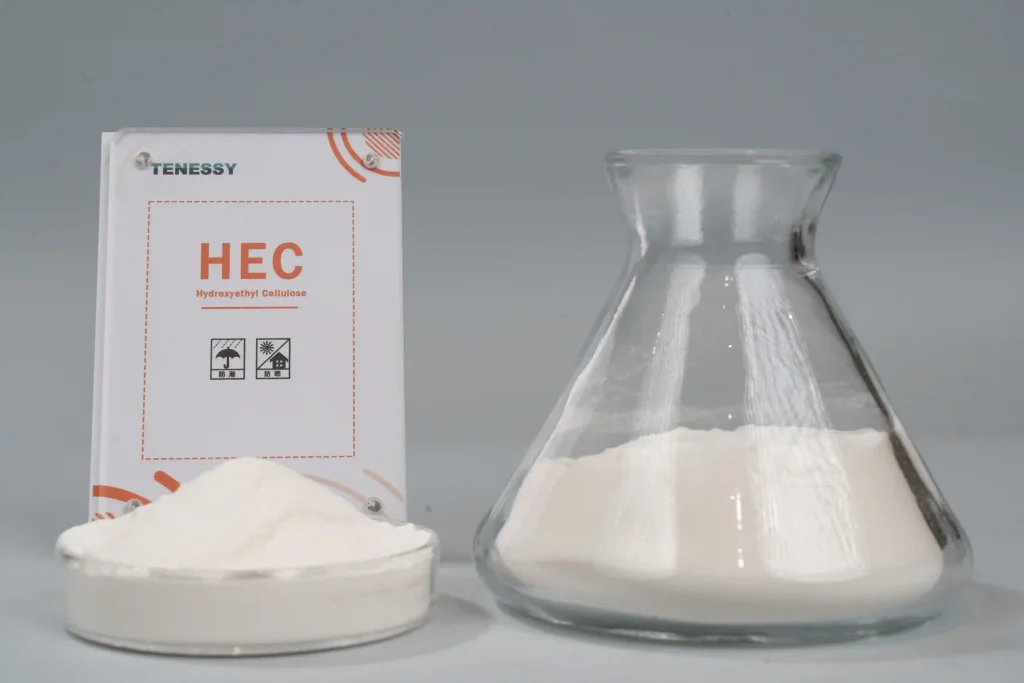
HEC is produced by etherification modification of natural cellulose. Its molecular chains contain abundant hydroxyl and hydroxyethyl groups, enabling rapid dissolution in cold water to form a uniform colloidal solution. In water-based fire-resistant coatings, HEC performs multiple key roles:
Fire-resistant coatings typically contain large amounts of pigments, fillers, and flame retardants, making viscosity control challenging.
HEC imparts pseudoplastic (shear-thinning) behavior:
This ensures uniform coating thickness and provides a stable base for intumescent expansion during fire exposure.
Key components of intumescent fire-resistant coatings include:
Due to density differences, sedimentation and hard settling can occur.
HEC forms a weak network structure that stabilizes solid particles, extends storage life, and prevents uneven fire performance caused by filler sedimentation.
HEC provides excellent water retention, slowing water evaporation and preventing defects such as:
It enhances coating adhesion and compactness while improving leveling properties, reducing brush marks and orange peel texture, thus balancing decorative and protective performance.
As a non-ionic cellulose ether, HEC exhibits:
It is compatible with emulsions, flame retardants, dispersants, and defoamers, without causing flocculation or phase separation.
HEC performs reliably under high temperature, dry, or high-salt environments, making it suitable for various water-based fire-resistant systems.
At high temperatures (>200°C), HEC decomposes rapidly without forming rigid residues that would hinder char formation.
By ensuring uniform, continuous, and dense coating films, HEC contributes to stable expansion, moderate foaming ratio, and enhanced thermal insulation performance during fire exposure.
In water-based fire-resistant systems, CMC, HPMC, و HEC are commonly used cellulose ethers. Their performance differences significantly influence application selection.
| Performance Index | HEC | CMC (Sodium Carboxymethyl Cellulose) | HPMC |
|---|---|---|---|
| Ionic Type | Non-ionic | Anionic | Non-ionic |
| Acid/Alkali & Electrolyte Resistance | ممتاز | Moderate, sensitive to electrolytes | جيد |
| احتباس الماء | ممتاز | متوسط | ممتاز |
| Suspension Stability | جيد | Strong | جيد |
| Film Formation & Appearance | Good, excellent leveling | Moderate, prone to skinning | Excellent, dense film |
| Thixotropy & Workability | Moderate, good sag resistance | Strong, high spray resistance | Moderate, smooth application |
| Suitability for Fire Coatings | Universal (ultra-thin, thin, thick types) | General water-based coatings | High-end film-forming coatings |
| Cost | متوسط | منخفضة | Higher |
Conclusion:
HEC offers the best overall balance in compatibility, electrolyte resistance, workability, and fire-coating adaptability. It is the preferred إيثر السليلوز السليلوز for water-based intumescent fire-resistant coatings.
Medium–High Viscosity (20,000–50,000 mPa·s)
Mainstream grade with optimal balance of thickening and suspension. Suitable for ultra-thin and thin steel structure coatings.
Low Viscosity (5,000–15,000 mPa·s)
Suitable for high-flow, spray-applied coatings with improved leveling.
Fast-dissolving/Dispersible HEC
Ideal for industrial production. Dissolves quickly without lumping, simplifying batching processes.
Ultra-thin / Thin Water-Based Fire Coatings:
0.3%–1.0% (Typical: 0.5%–0.8%)
Thick Fire-Resistant Coatings:
0.5%–1.5%, often combined with bentonite or fumed silica.
Excessive dosage may cause overly high viscosity and slow drying; insufficient dosage may reduce suspension stability and sag resistance.
| المكوّن | Weight % | الوظيفة |
|---|---|---|
| Acrylic Emulsion | 24–28 | Film-forming binder, adhesion |
| Ammonium Polyphosphate (APP) | 30–35 | Acid source, promotes char formation |
| Pentaerythritol | 14–16 | Carbon source |
| Melamine | 10–13 | Gas source, foaming expansion |
| Titanium Dioxide / Hollow Microspheres | 6–9 | Filler, insulation and reinforcement |
| HEC (28,000 mPa·s) | 0.5–0.7 | Thickening, suspension, water retention |
| Dispersant / Defoamer | 0.4–0.8 | Improves dispersion and application |
| المياه | Balance | Solvent |
This formulation provides good workability, storage stability, smooth coating surface, and rapid formation of a dense insulating char layer during fire exposure, meeting fire resistance rating requirements.
تتمتع TENESSY بأكثر من 10 سنوات من الخبرة في الإنتاج ومعدات الإنتاج المتقدمة.


املأ بياناتك للحصول على عينة مجانية أو استشر للحصول على مزيد من المعلومات.
